
QBioS Students Win 2026 NSF Graduate Research Fellowship Program Awards
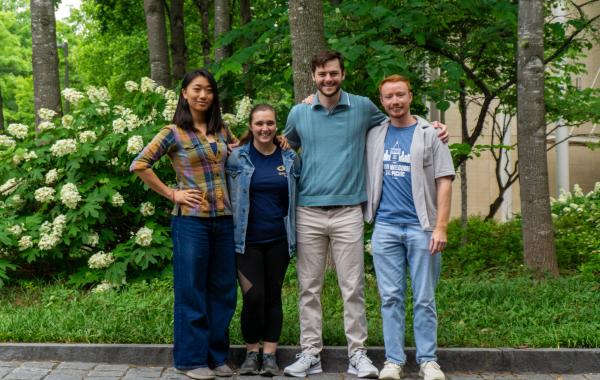
QBioS Fellowship Winners
The Quantitative Biosciences PhD Program at Georgia Tech is proud to announce that four students from our 2025 cohort received NSF Graduate Research Fellowship Program (GRFP) award offers for 2026. The U.S. National Science Foundation selected 2600 GRFP recipients from a pool of nearly 14,000 applicants nationwide. The NSF-GRFP is one of the nation’s most prestigious fellowship programs, providing three years of financial support, including tuition and stipend for PhD study, over five years.
To be eligible for the fellowship, graduate students must be U.S. citizens, nationals, or permanent residents in their first year of graduate study. The QBioS program had six students in our first-year cohort who were eligible to apply. Of those six, four were offered fellowships and one received an honorable mention. With four fellowship recipients, QBioS represented the highest number of awardees among PhD programs in the College of Sciences. Notably, our four awardees span four distinct NSF field categories, which reflects the interdisciplinary character of the QBioS PhD program.
During their first semester at Georgia Tech, QBioS students take a “Professional Development in Quantitative Biosciences” seminar, taught by Professor Sam Brown. In most years, the course focuses on grant-writing, conferences, publishing, and other professional development topics uniformly, but this year’s cohort expressed more interest in writing grants than any of the other subjects. Professor Brown’s lectures highlighted how the review process works and how students should write their proposals to make them as effective as possible. In some classes, students would share their proposals with the class and get feedback. Finally, before the GRFP was due, the students did mock grant panels based on the NSF's official process. Current QBioS student, Brendan Shrader, explained the process:
“Everyone in the room (except the person whose proposal was being reviewed) was a panelist, but only three panelists actually read the proposal beforehand, and only one was able to present it to the other panelists. After they give a 2-minute summary, the other panelists could ask questions, and then they scored it. It was eye-opening to actually hear someone talk about my proposal and see what they thought was important, what they did/didn't understand, what they thought was missing, and how they responded to other panelists' questions.”
Here is some additional information about each of the QBioS fellowship awardees and their proposed PhD Research.
Sierra Paige Bornheim (NSF field: Life Sciences, Ecology) is advised by Professor Jenny McGuire. Sierra plans to study the effects of climate change on bird distributions in North America since the Last Glacial Maximum. While the role of interglacial warming in North America on mammalian and plant communities has been extensively studied, the impact on avian species remains completely unexplored. By understanding the factors that shaped bird distributions in the past, we can better predict how current and future ecological disruptions may affect avian communities, which can serve as a leading indicator of how climate change will affect less susceptible taxa.
Brice Bradley Edelman (NSF field: Comp/IS/Eng, Artificial Intelligence) is advised by Professor Jeffrey Skolnick. Brice’s proposed doctoral research aims to improve our understanding of pain as a multiscale nervous-system phenomenon. He seeks to understand how biological signals are detected, transmitted, transformed, and maintained across levels of organization, from molecular interactions and sensory neurons to peripheral tissues and brain-wide circuits. His work in systems biology uses computational and data-driven approaches to connect mechanisms of peripheral neuropathy, pain persistence, treatment response, and neuropsychiatric disease. By integrating molecular, cellular, tissue-level, and neuroimaging data, his research aims to identify clearer disease states, better biomarkers, and more precise therapeutic strategies for conditions ranging from chronic pain to disorders of brain-circuit regulation.
Brendan Michael Shrader (NSF field: Mathematical Sciences, Mathematical Biology) is advised by Professors Rachel Kuske and Sam Brown. Brendan's GRFP proposal is titled "Cellular noise versus population synchrony: stochastic modeling of genetic regulation in Pseudomonas aeruginosa." His project is on mathematical modeling of quorum sensing, a bacterial communication system, to understand how phenotypic heterogeneity arises in bacterial communities, particularly for the opportunistic pathogen Pseudomonas aeruginosa. His work will be primarily computational, focusing on the derivation and analysis of stochastic models at both the single-cell and population levels, along with comparisons to experimental data. This project provides Brendan an opportunity to apply new mathematical methods while gaining biologically relevant insights into the dynamics of quorum sensing.
Yufei Xiao (NSF field: Physics and Astronomy, Physics of Living Systems), is advised by Professor Saad Bhamla. Yufei's doctoral research focuses on how active agents pattern their environments, and what physical principles drive adaptive patterning. In this project, she uses subterranean termites as a model system to study how perceptually limited individuals produce large-scale environment modification, such as the transition from exploratory to transport-focused architectures in shelter tube networks during foraging. The team combines theory, controlled experiments, and synthetic analogues to investigate the mechanisms underlying this transition, including the role of clog resolution and geometry sensing. The broader aim is to extend the framework to other ecosystem engineers, such as how pastoralists steward grazing livestock to regenerate grasslands.